

From an early age, we’ve been sold the image of sadness as something beautiful: the fruity-eyed face mask after heartbreak, or the ambient airplane-window stare set to a film score. The aestheticisation of female sadness is nothing new. It’s been repackaged and has since evolved into many forms, including The Sad Girl or in recent terms, The Thought Daughter. If those don’t ring a bell, let’s try The Manic Pixie Dream Girl. But within fashion, beyond the comfort of fuzzy robes and slippers, how does female sadness actually express itself?
Edgar Allan Poe wrote, “The death of a beautiful woman is unquestionably the most poetical topic in the world.” Every season, ‘Ophelia’ figures show up on the runway—not necessarily dead, but somewhere in the midst of actively dying: sporting straitjacket chic, fashion-forward opioid addiction, and, of course, the novel noose hoodie.

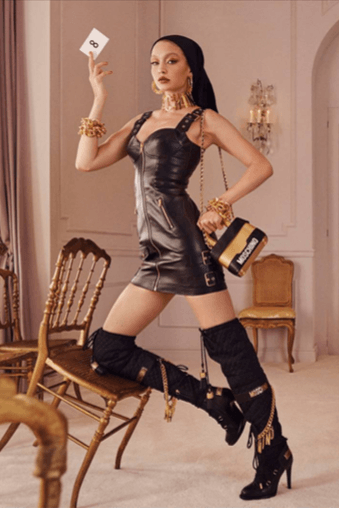
Moschino SS 2017 'Capsule Collection'
Photo: Instagram @moschino

Burberry Ready to Wear Fall 2019, photographed in London on Feb 17, 2019.
Photo: Giovanni Giannoni/WWD/Penske Media/Getty Images
I hear you, EAP. There’s something undeniably sexy about the post-cry mirror stare: fingers turned claws, going through unkempt hair, the salted flavour on pouty lips, and that moody dead-eye stare. Admittedly, I, too, a self proclaimed ‘beautiful woman,’ can find beauty—even poetry—in some of my lowest moments. But my question is: Why do we so often see female tragedy as inherently beautiful? And how did symbols of mental health struggles—straightjackets, razor blades, even nooses—become chic accessories on the runway?
“For me, the questions that are relevant but never get answered,” begs Angela McRobbie, cultural, feminist scholar at the University of London, “Who are the decision-makers behind the scenes? Who signs off on blatantly offensive items like this? When there’s backlash, do they get fired? Or is there a cynical agenda to shock, then rapidly withdraw the offending piece for the media attention it generates?”
With polka dots and pinstripes traded for razor blades and prescription pills on the runway, one has to ask: who is this all for? Is this new wave of DSM-designers simply a marketing stunt to offend mainstream media? Is glorified agony the push we really need to de-stigmatize mental illness? These questions demand answers—yet the fashion industry remains frustratingly opaque.
Personally, when I’m in the depths of sadness, my blotchy skin couldn’t be further from the flawless, filtered complexions of Moschino’s Spring/Summer 2017 show. My puffy tear-streaked eyes don’t pair with runway-ready falsies or the glittering ornamentation of gold accessories, like those at Gucci’s 2020 show. For years, the fashion industry has paired explicit cries for help with designer glamour—remember Heroin Chic, with its smoky eyes, pale bodies, and hollow stares? Though some modern fashion choices aren’t as direct in referencing mental and physical health issues, I cannot, in good conscience, get behind female tragedy as an aesthetic ideal.

Namilia SS 2025, photographed on July 9, 2024 in Berlin.
Photo: Vogue Runway

Gucci Ready to Wear Fall/Winter 2020-2021, photographed in Milan on February 19, 2020.
Photo: Victor VIRGILE/Gamma-Rapho/Getty Images

Moschino SS 2017, photographed on September 22, 2016 in Milan.
Photo: Tristan Fewings/Getty Images for MOSCHINO
Is it raw? Is it real? Are these important topics to talk about? Absolutely. But my problem lies in how these images are presented: preserving the pretty while erasing the off-runway realities. Watching the ‘I heart Ozempic’ shirt presented in glimmering lights with nothing as even a hint towards the fact that anorexia is the mental illness with the highest mortality rate. Runway shows present the ‘ready-to-wear asylum patient’ without acknowledging the stark reality: 42% of Gen Z has an official mental health diagnosis, and nearly half of fashion consumers belong to this demographic. The overlap between these struggling audiences and the glamorization of suffering is alarming.
This isn’t to say art shouldn’t provoke, satirize, or use metaphor—I’m not that sensitive, God. But pushing boundaries and the thrill of ‘edginess’ have lost their roots in fostering mainstream critique. There’s a thin line where awareness becomes saturation—if awareness was even ever the intention at all. The Sad Girl, The Thought Daughter, The Manic Pixie Dream Girl or however else you wish to identify, have drained any hope of real provocation, collapsing into hollow hashtags and aesthetic ‘cores.’ The essential conversations of problematic societal phenomena have been funnelled into what looks like a celebration—a poster-ready glamorization of the severe, silent suffering, actively being shared by millions of people.
As the late Vivienne Westwood said, “If it’s popular, it’s not culture.” This sentiment rings truer than ever as the aestheticisation of mental illness lights up our screens during fashion week. By glamourizing suffering, the industry risks turning real struggles into hollow trends, erasing the realities of those who live them every day.

Editor
Dionne Wong